A digital evidence platform (consulting, name withheld) · 2026
Evidence platformTwo weeks on a video-redaction tool
A two-week consulting engagement to fix the video and audio redaction workspace inside a chain-of-custody digital evidence platform trusted by 400+ US law-enforcement agencies. Twelve issues found. Fourteen changes designed. One designer.
- Role
- Product design consultant, solo
- Client
- A digital evidence platform (consulting, name withheld)
- Timeline
- 2 weeks, 2026
- Platform
- Web: evidence management platform
Cover mockup comingA digital evidence platform (consulting, name withheld)
The context
The client is a digital evidence management system for US law enforcement and prosecutor offices: the platform where an agency puts its body-cam footage, phone dumps, CCTV, and case files, and where the chain of custody around every piece of that evidence gets tracked, automatically, so it holds up when it reaches a courtroom.
The product is used by more than 400 law-enforcement agencies and prosecutor offices, and its whole reason for existing is a promise the platform can defend: an automated, immutable audit log for every action taken on every piece of evidence. It meets CJIS, SOC 2, HIPAA, and FIPS compliance, and it’s hosted on AWS as a certified Public Sector Partner.
The engagement was narrow on purpose. The company brought me in as a product design consultant to focus on one thing: the video and audio redaction workspace, where an officer or paralegal blacks out a face, silences a name, and produces an export the court can rely on. Two weeks, one designer, deep in that one surface. The mandate:
- Find every usability failure in the beta redaction editor by working through it as a real user would, not as a QA tester.
- Design fixes that respect the platform’s compliance posture: a redesign that broke chain of custody or made an action untraceable was worse than one that shipped an ugly button.
- Hand over prototypes engineering could ship from directly: screens, states, prototype links, reference sets.
How I audited it in two weeks
Two weeks is about the length of a new design lead’s first audit, and I ran it that way: map every issue, rank them by what could go wrong once the evidence reaches court, and name up front the principles every fix would be argued against.
Twelve issues in the beta editor: three critical, six moderate, three minor. The critical three were the ones that would let a court’s attorney embarrass an officer on the stand.
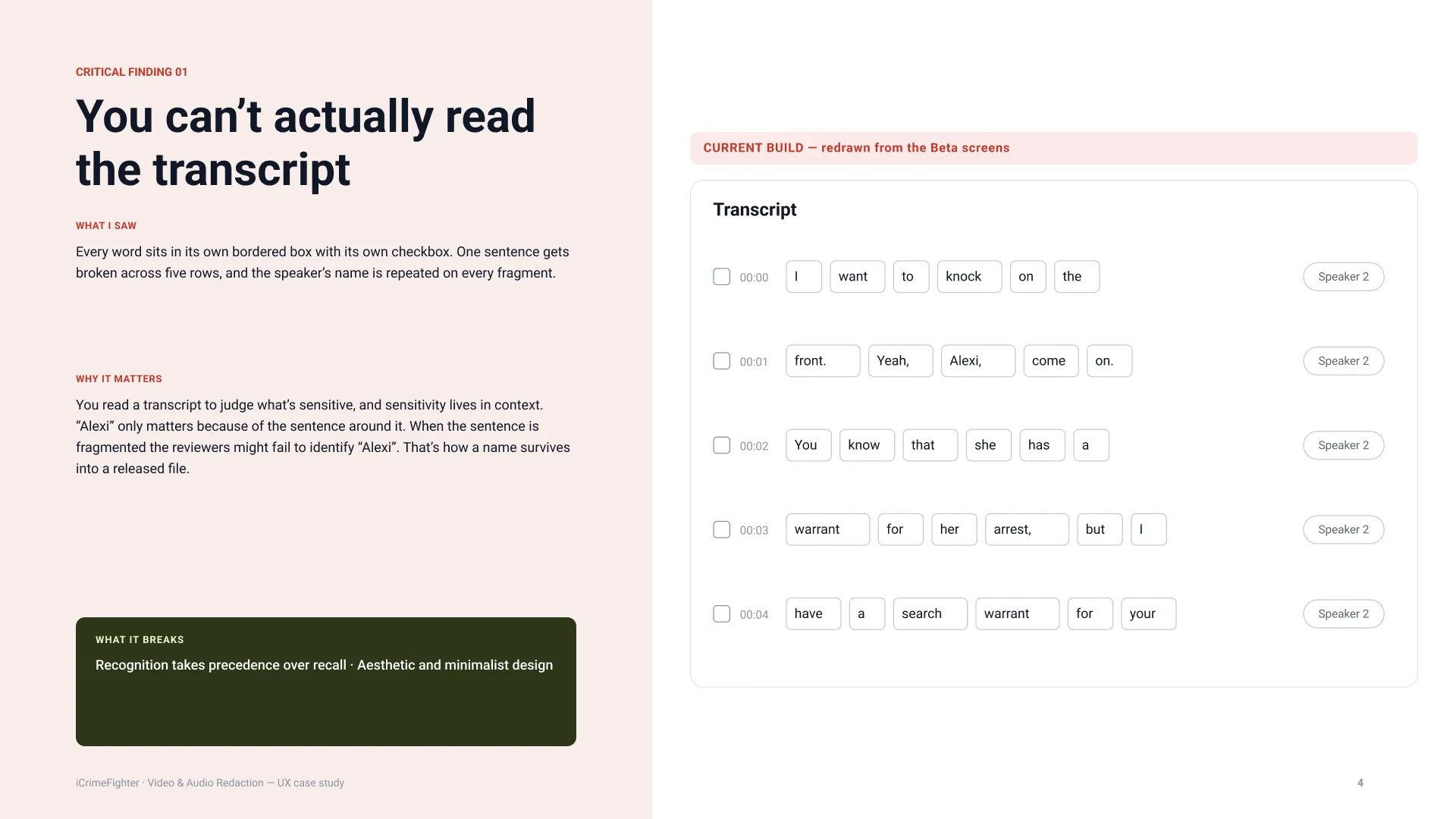
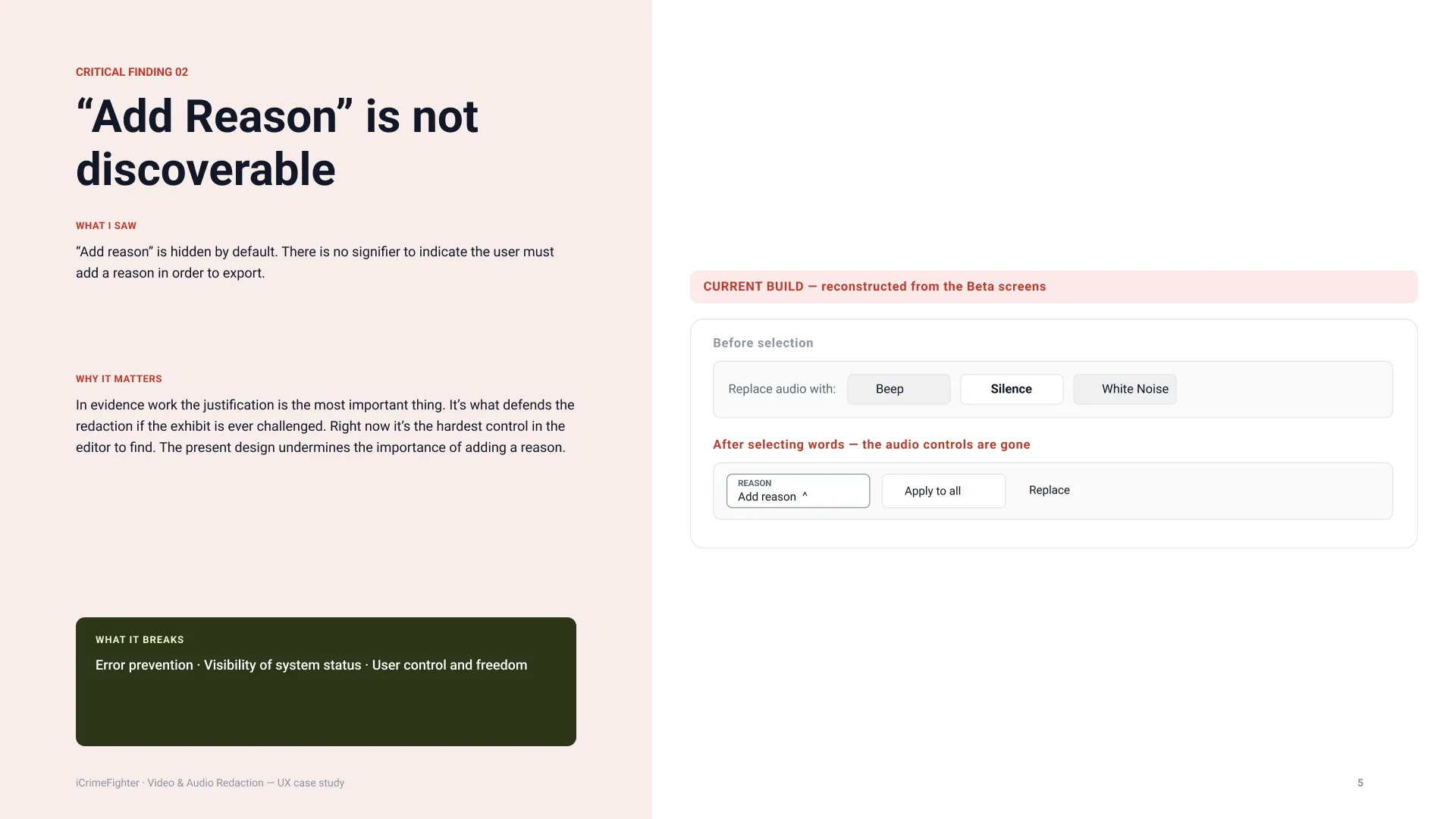
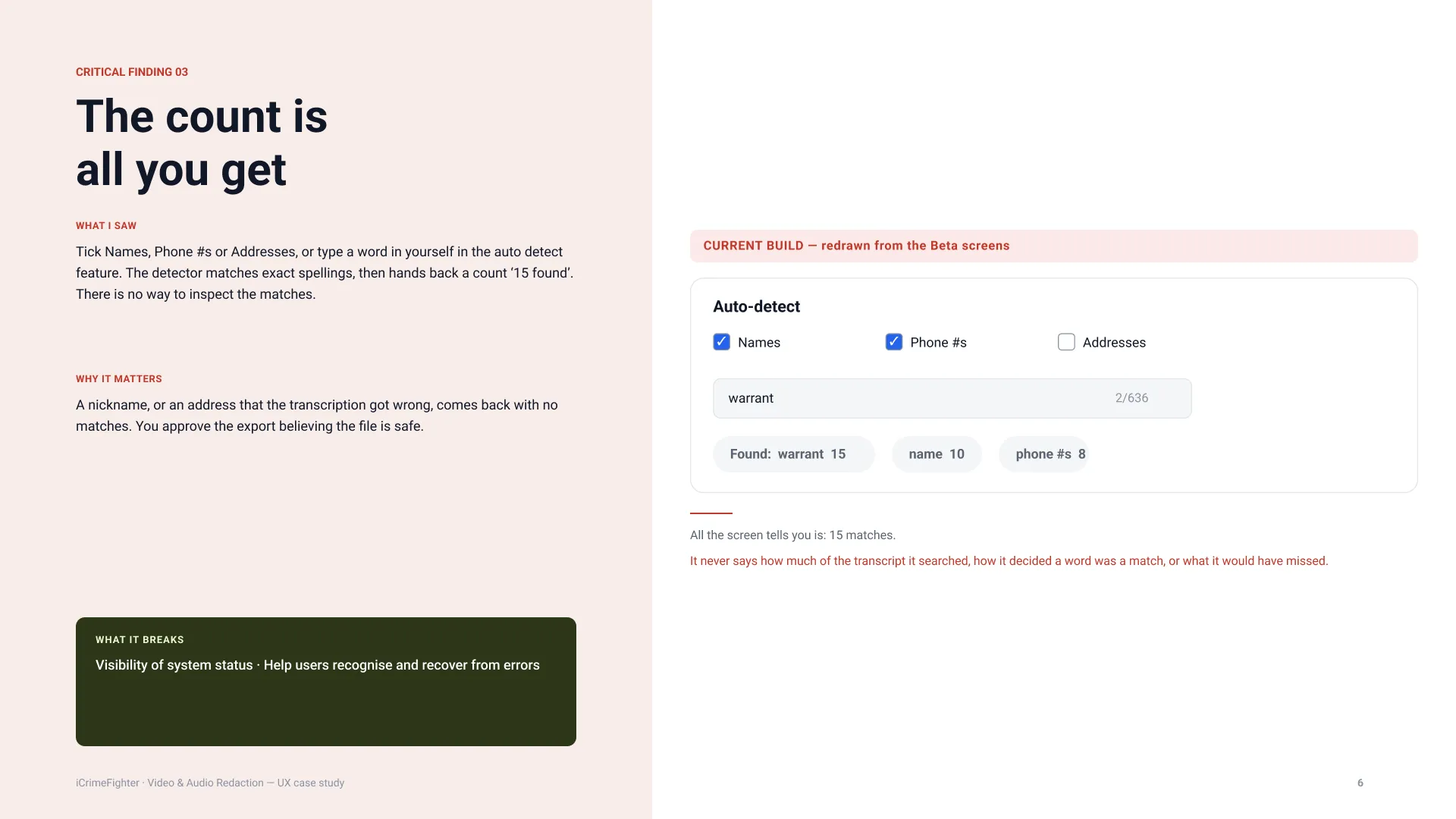
Every fix was argued against six heuristics I named up front: visibility of system status, error prevention, recognition over recall, consistency and standards, progressive disclosure, and Jakob’s law. Naming them first kept every change defensible in review, and gave the engineering team a lens to inherit. Fourteen changes came out of it; these five mattered most.
Key decisions
Decision 01
A transcript that reads like a transcript
- On the table
- One word per box, each with its own checkbox
- Continuous sentences, the speaker named once
- What I chose
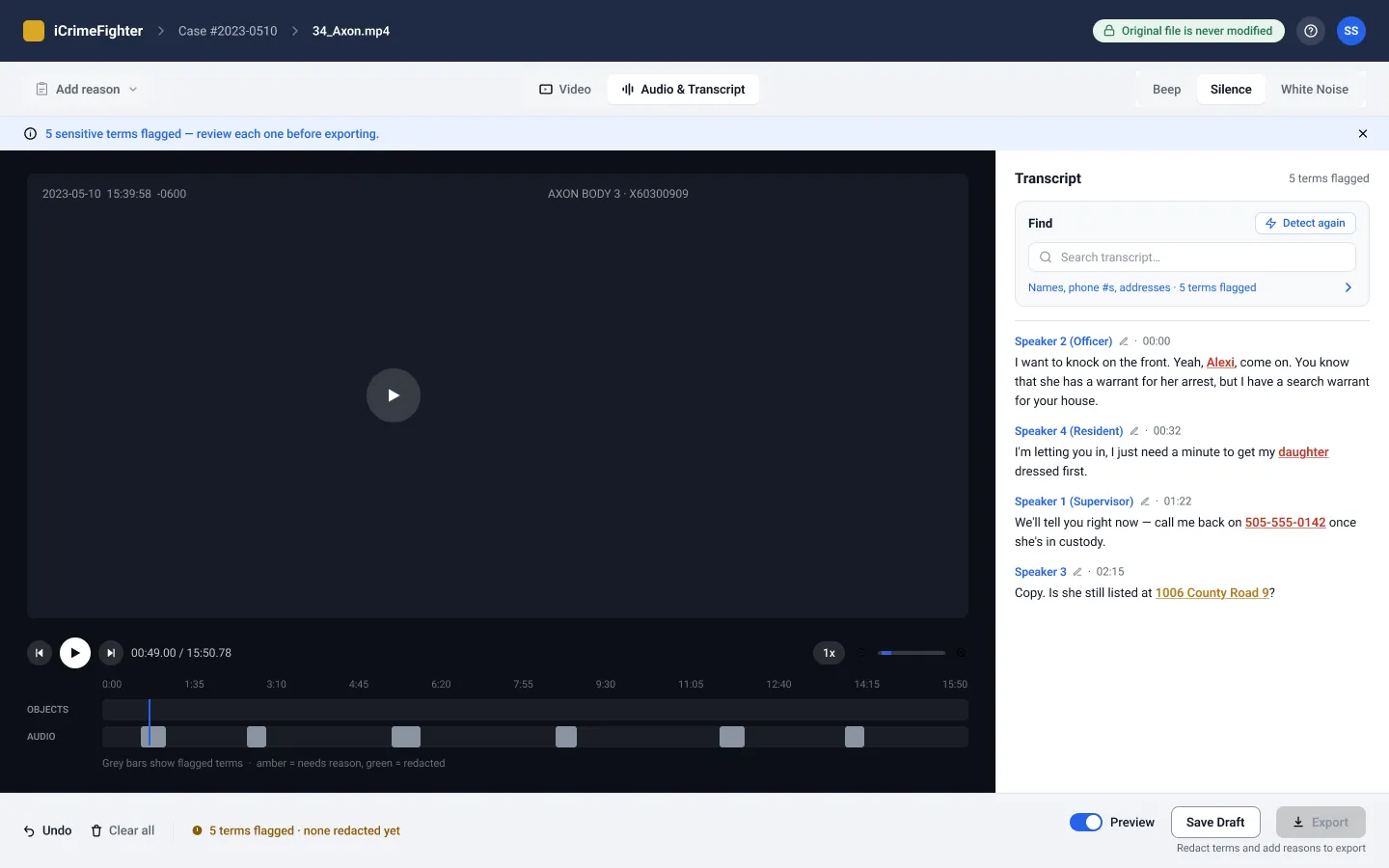
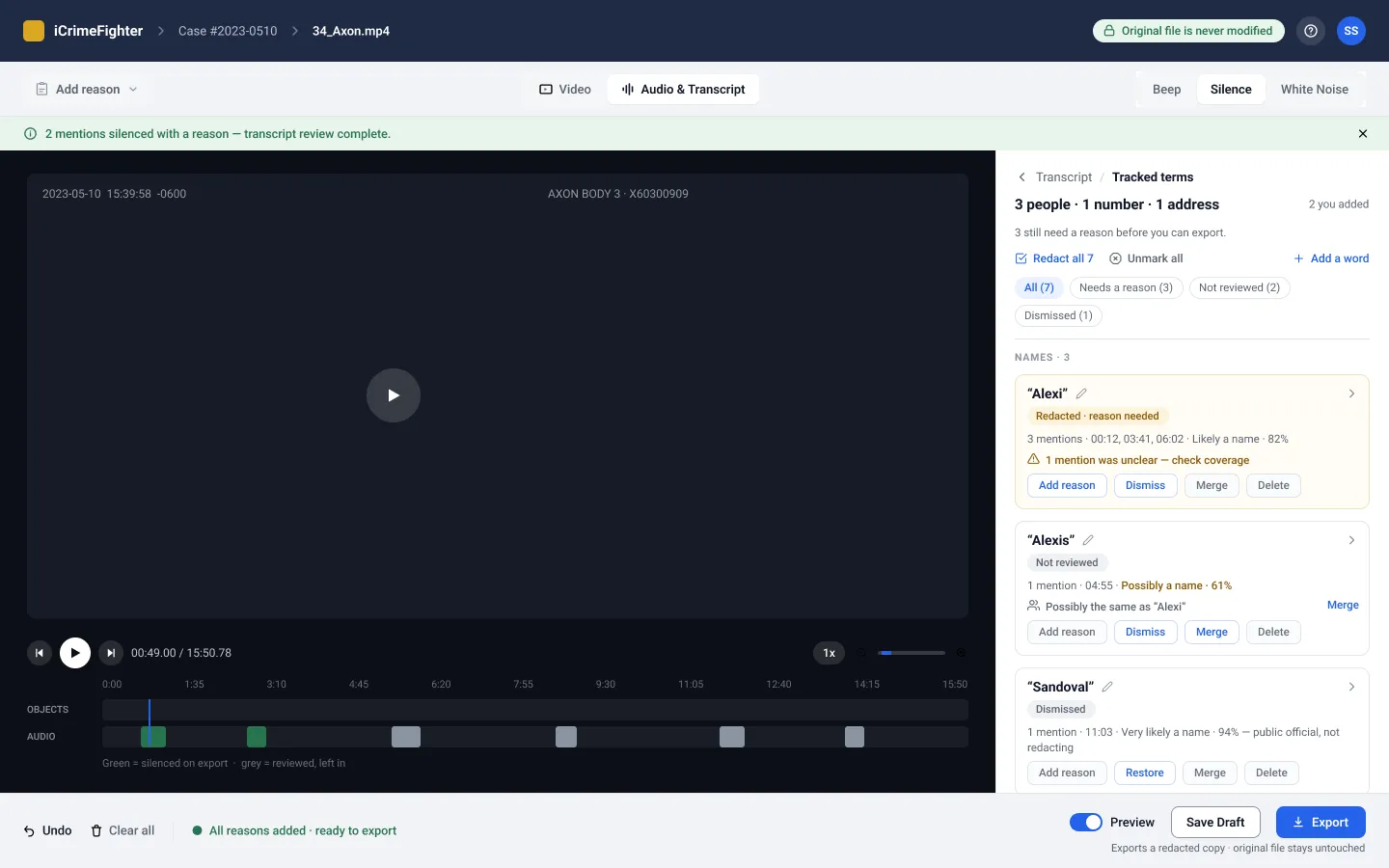
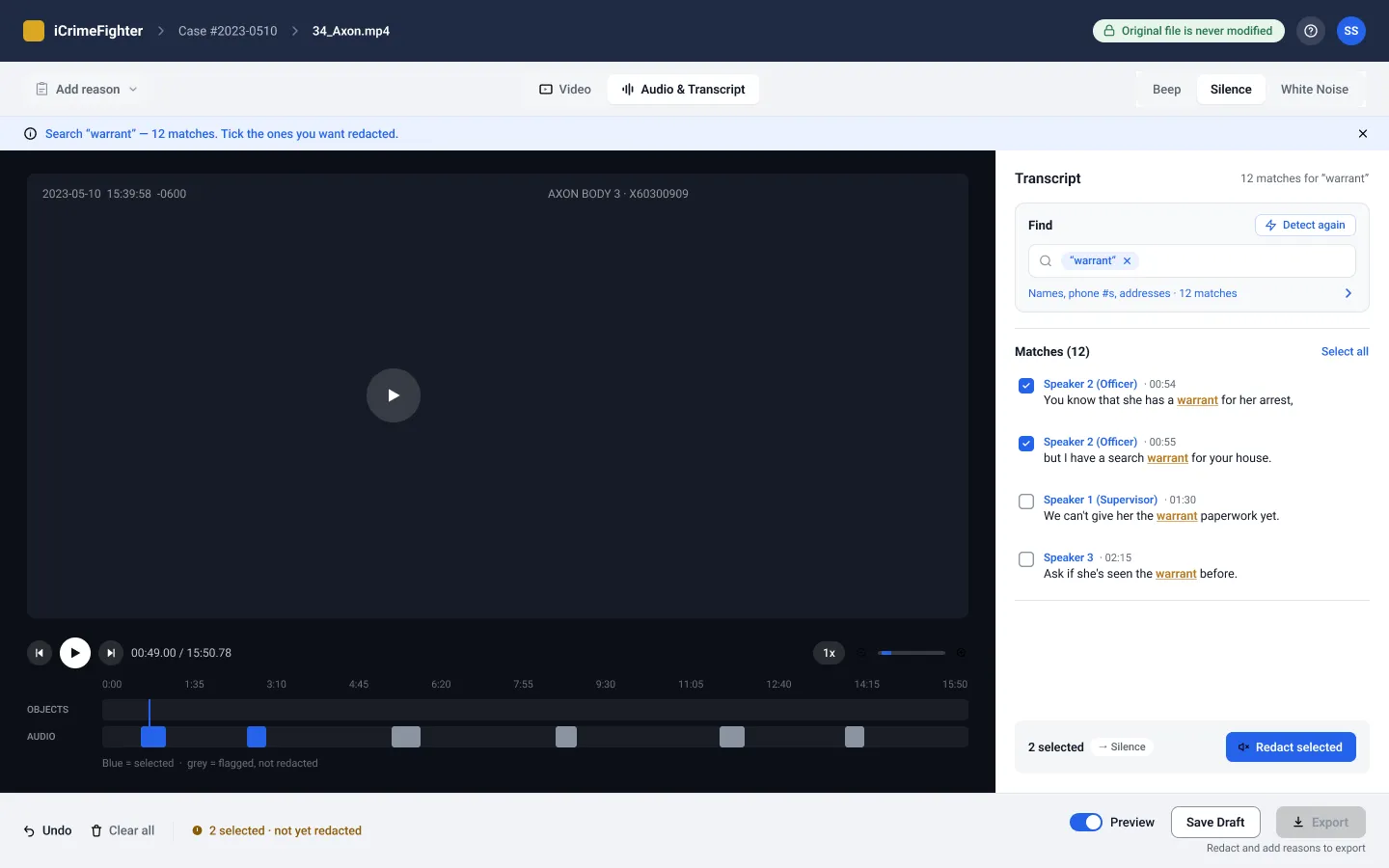
- Dialogue runs as continuous sentences, the speaker is named once and can be renamed to a real role, and detected terms are underlined and colour-coded where they sit.
Why
In the beta, every word sat in its own bordered box with its own checkbox, so one sentence spread across five rows and the speaker’s name repeated on each piece. Now a reviewer can judge sensitivity in full context: red for redacted with a reason, dark yellow for redacted without one yet.
Decision 02
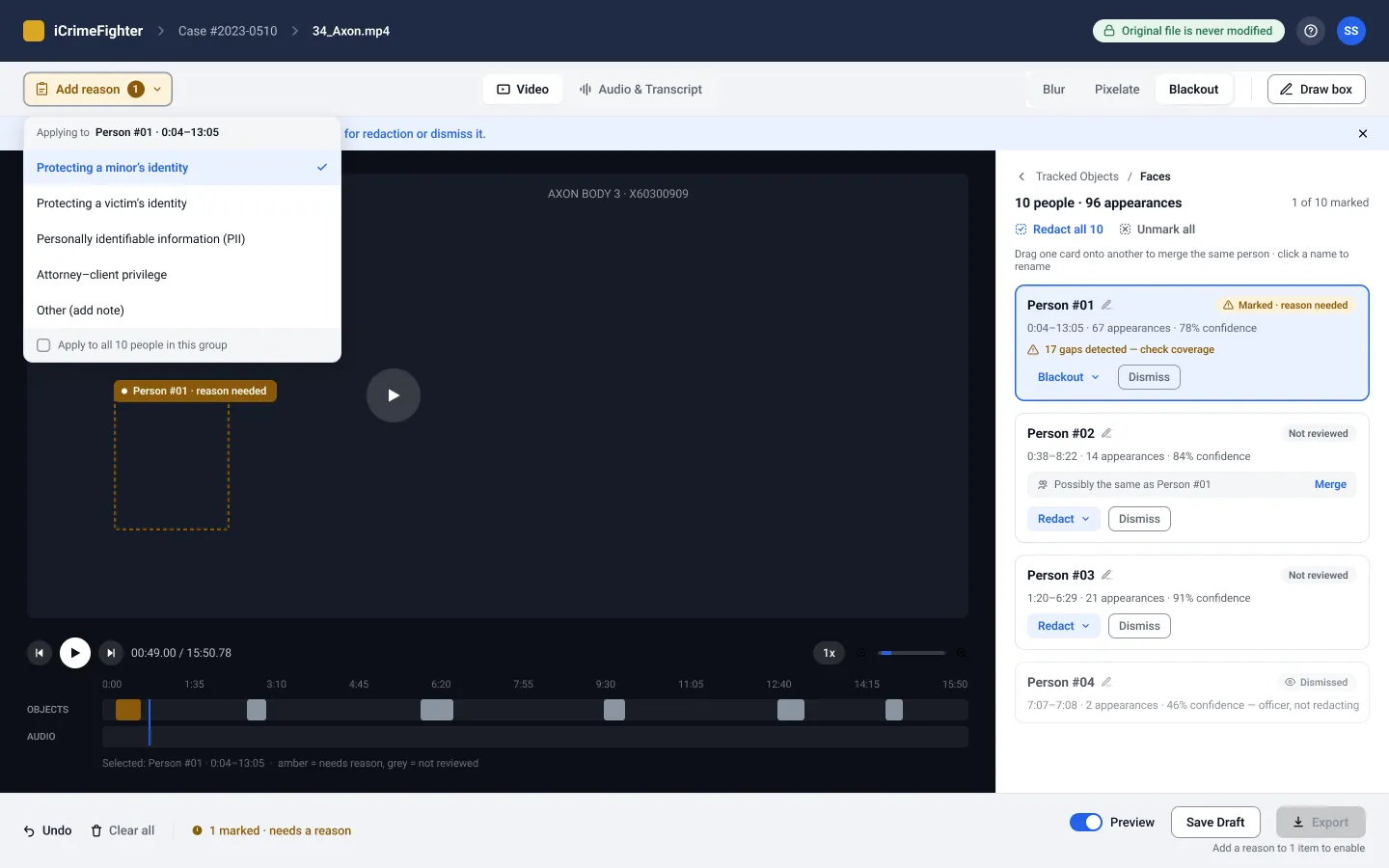
Every redaction has to say why
- On the table
- A reason dropdown that appears only on selection
- A global “Add reason” with a fixed list of justifications
- What I chose
- “Add reason” is a global control with a fixed list of accepted justifications. It says exactly what it’s about to apply to, and offers to cover the whole group.
Why
In the beta, the “Add Reason” dropdown appeared only when you selected something, and pushed the video and audio controls out of the way when it did. Now it always sits in the same place on the secondary bar, and nothing can be exported undocumented.
Decision 03
Detection you can inspect, not just a count
- On the table
- A count of what was found
- Every finding listed, with confidence and what still needs attention
- What I chose
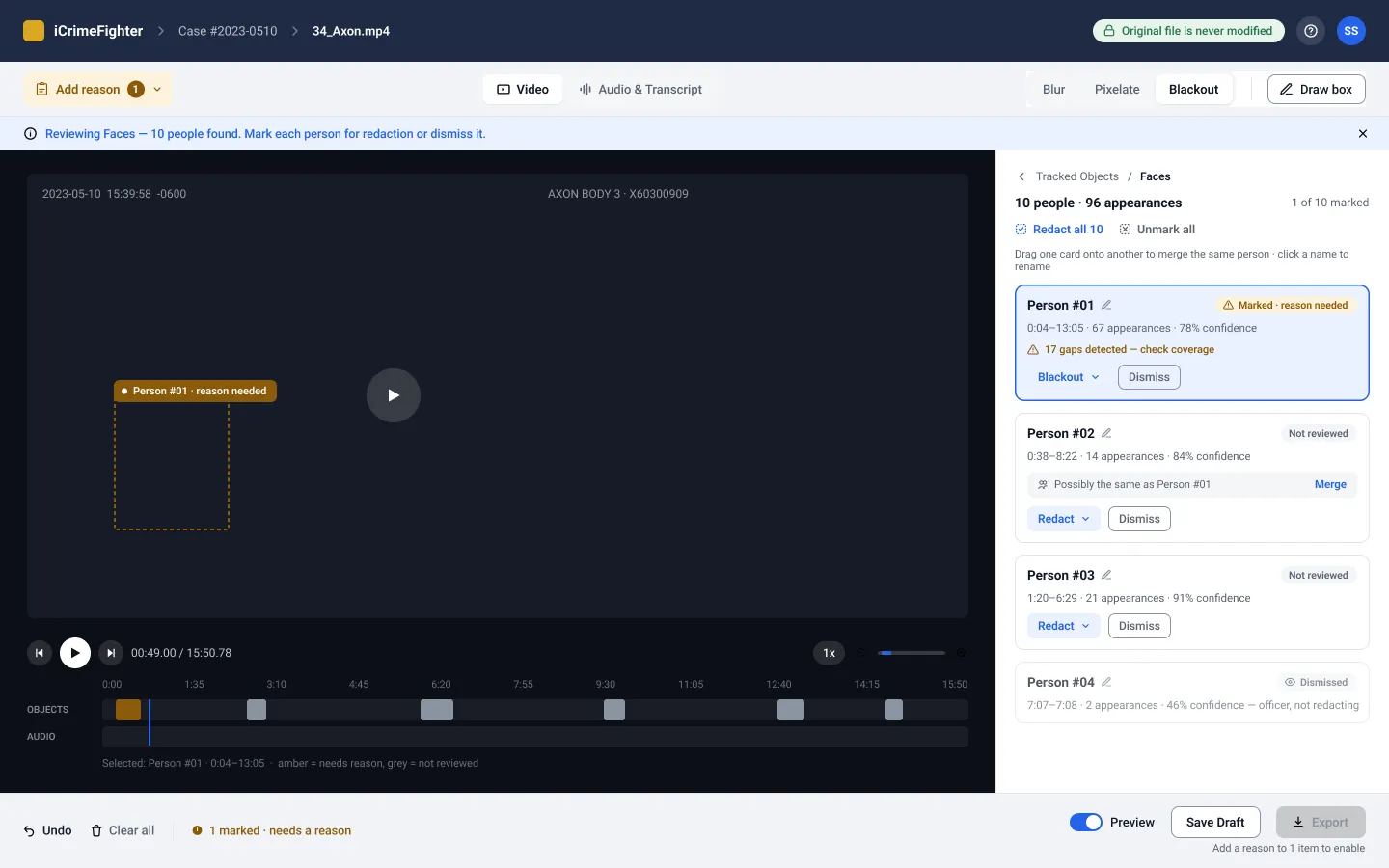
- Each person or term gets its own card, with a confidence score, how often it appears, a warning where coverage is uncertain, and the same actions on every card.
Why
The beta said “101 tracked” and then gave a hundred time ranges in one block, or “15 found” with no way to see the matches. Now a reviewer can spend their time on Person #01, at 78% confidence with seventeen gaps, and move quickly past a clean 84%. Duplicates are suggested for merging, with an undo, and a review list filters what still needs a reason. Detection stops being a black box you either trust blindly or check all over again.
Decision 04
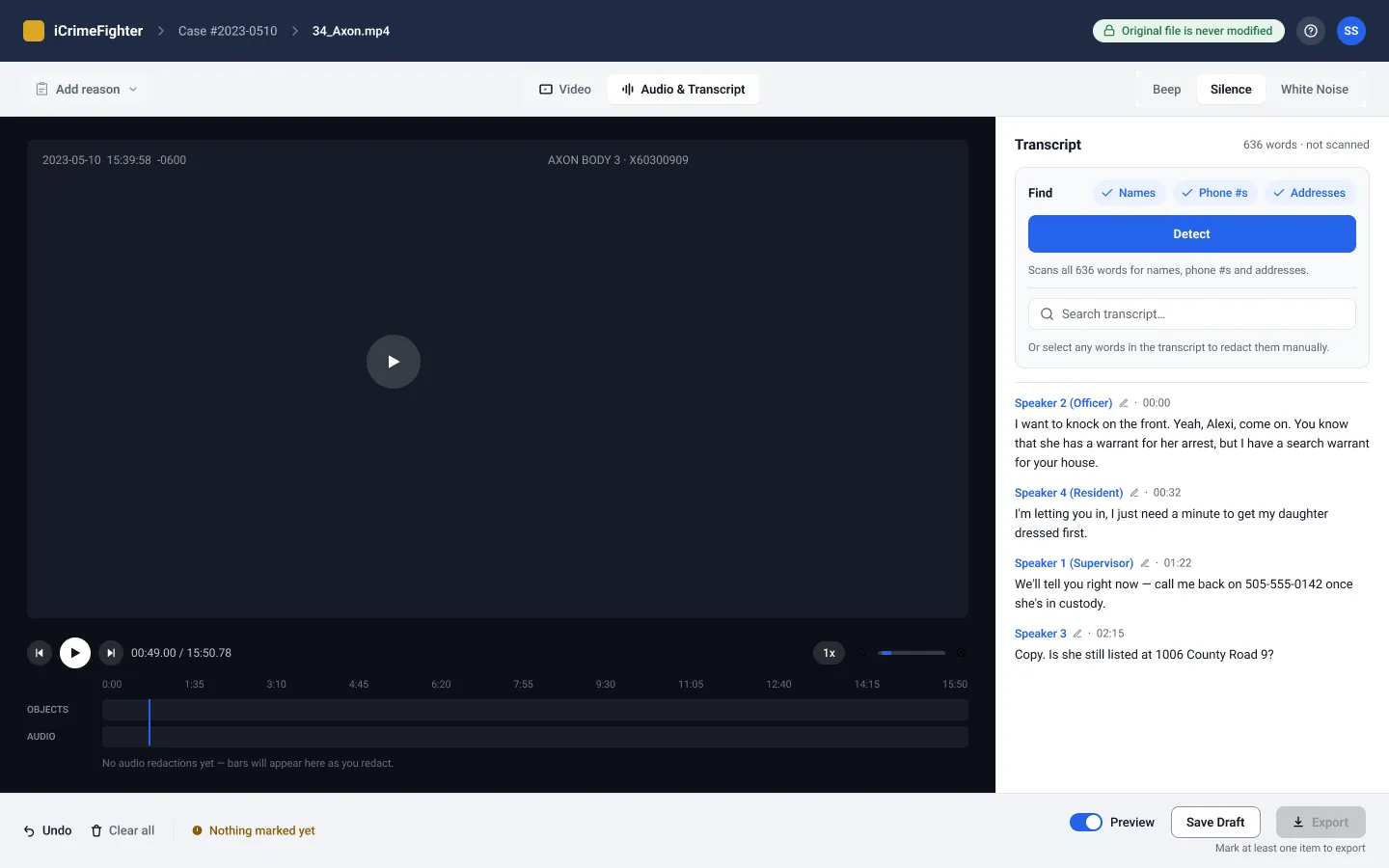
One workspace, two modes
- On the table
- Separate toolbars that change as you move
- One header with a single mode switch
- What I chose
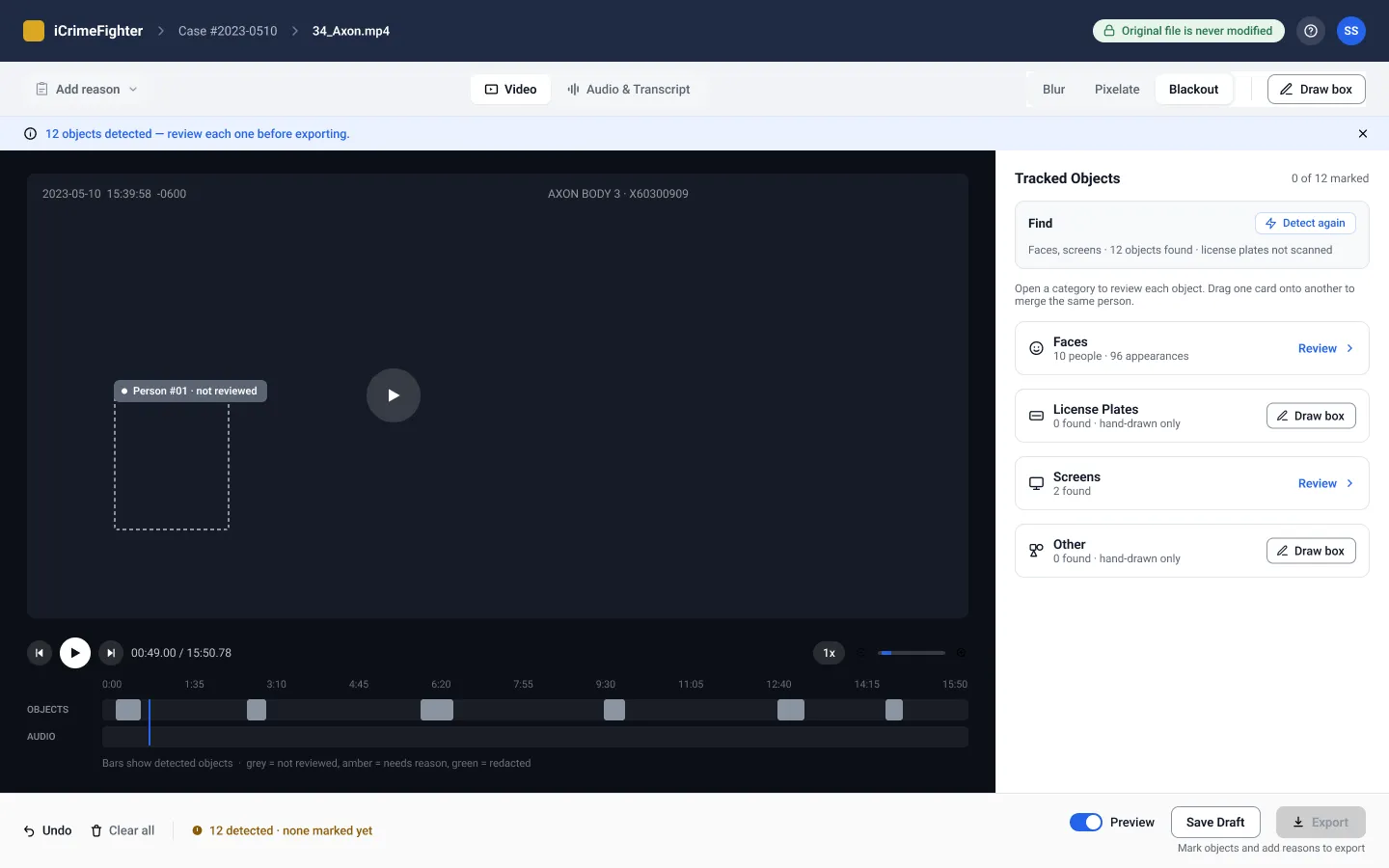
- A single header with one switch between “Video” and “Audio & Transcript” in the centre, and each mode’s controls in the same place on the right.
Why
In the beta, the video and audio toggle sat in the right corner of the secondary bar, with different toolbars on the left. Controls appeared and disappeared as you moved between them, and the audio options were duplicated onto the video tab. Now you stop re-reading the screen every time you switch, and where the reason, modes and controls live becomes second nature.
Decision 05
A redaction log that outlives the session
- On the table
- Leave the reasons in the editor
- Export a redaction log with every file
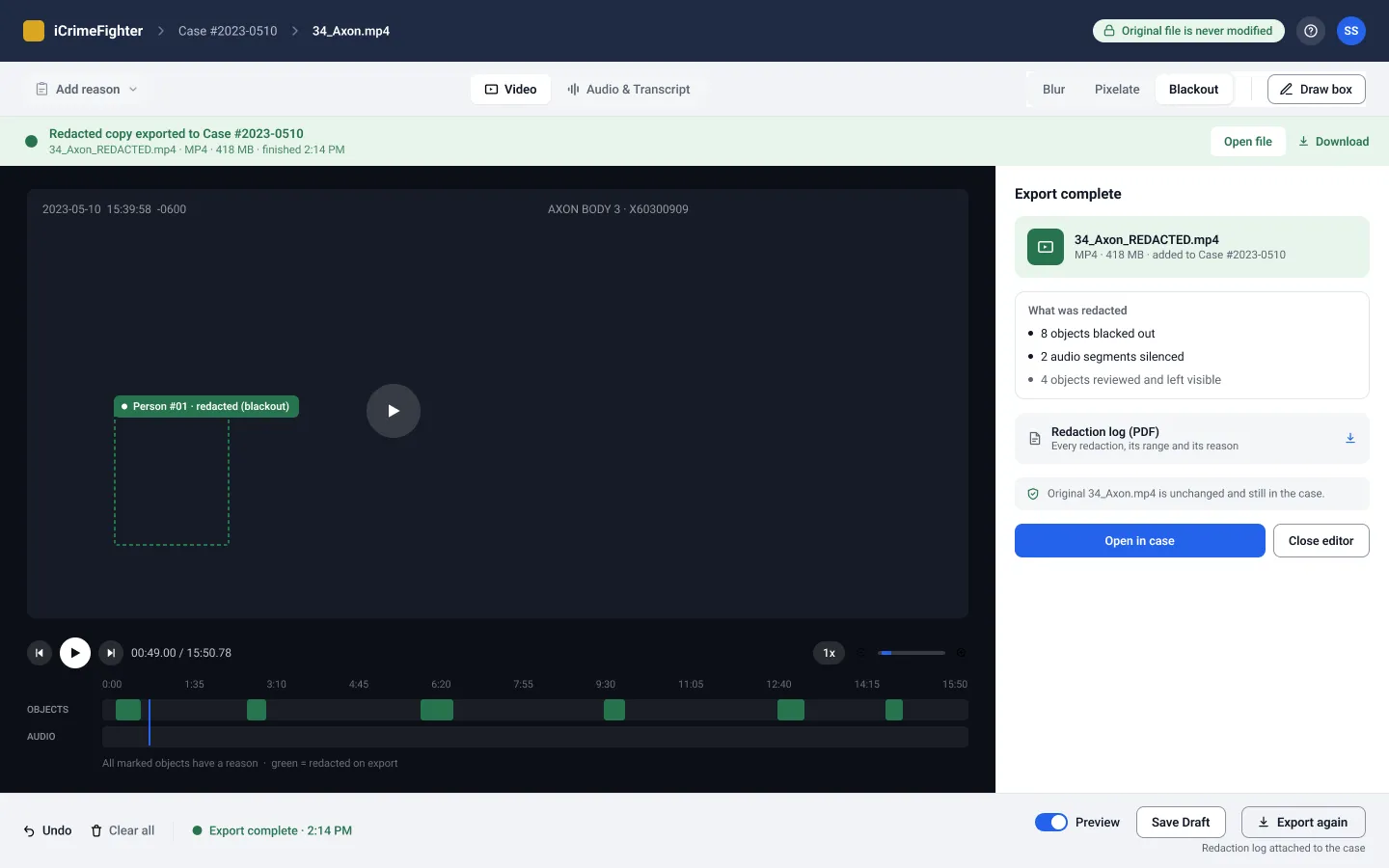
- What I chose
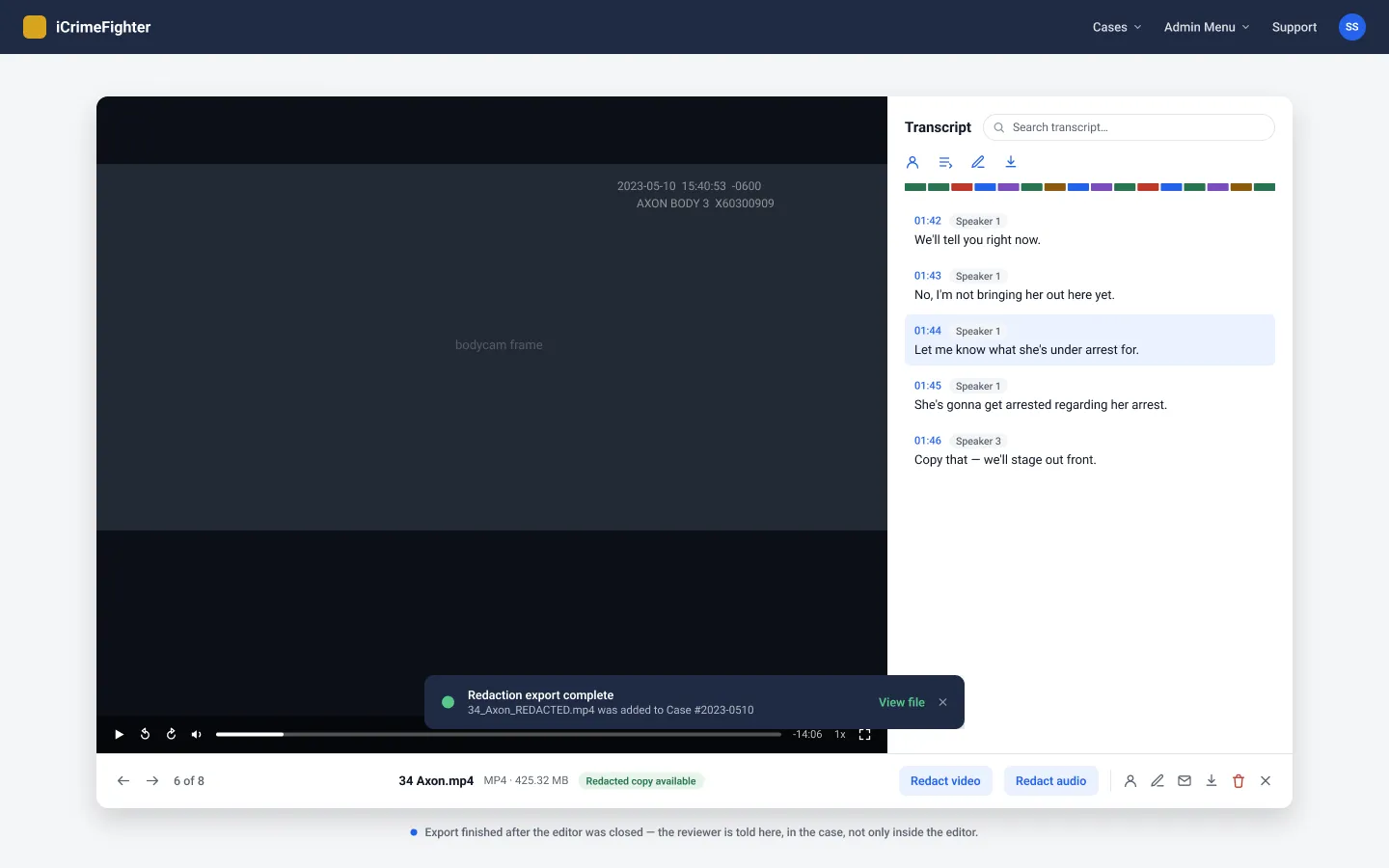
- Every export produces a redaction log: each redaction, its time range, its treatment and its reason, as a downloadable PDF attached to the case.
Why
This was the change I fought for hardest. In the beta, the reasons for each redaction were never seen after export. Six months later, a defence attorney asks why a second was silenced, and the answer has to come from someone’s memory.
A log outside the export is a new artefact in the compliance chain: it has to be as tamper-evident as the export, travel with the case, and be legible to someone who didn’t create it. The easy design was to leave the reasons in the editor. The right one was to make them part of the record, so a challenge made months later is answered from the record, not from memory.
Results
The redesign was handed over in August 2026: 26 screens covering the full flow, 41 prototype links so a PM or engineer could walk it without opening Figma, and 3 reference sets explaining the intent, the mapped issues and the WCAG measurements. I’m still working with the client, and what happens to a design after handover on a compliance product is the client’s journey. I don’t have production usage numbers for this feature, and I’m not going to invent them.
What I stand behind from the two weeks:
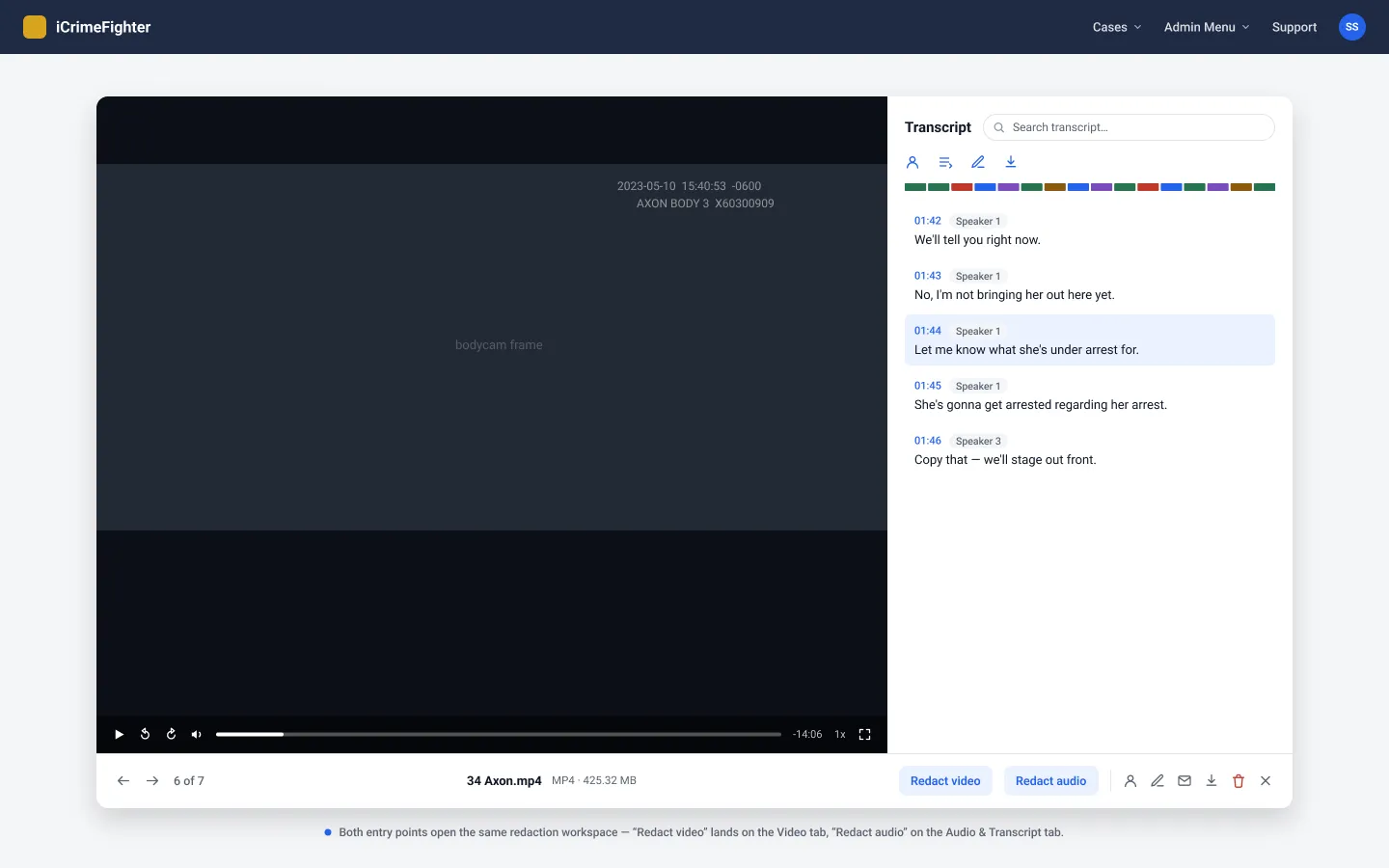
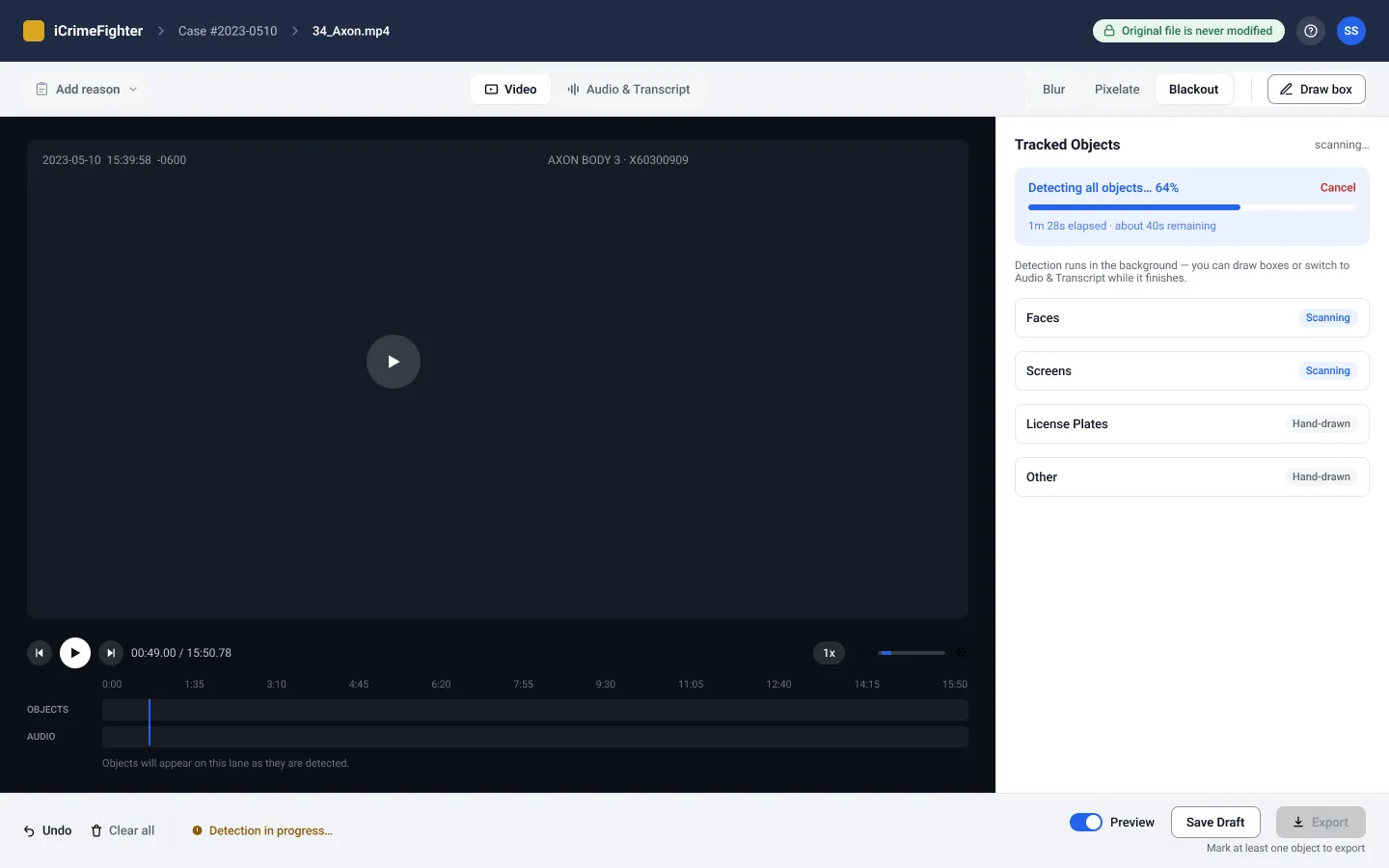
- All twelve beta issues were closed with a specific change and a heuristic behind it, including the smaller ones: search, select and redact in bulk; one “Detect” for both modes; progress that says “about 40s remaining”; a timeline that shows what’s left to do; warnings only when they matter; one export confirmation instead of two pop-ups; and selective redaction of a person’s time ranges.
- The redaction log is a new compliance artefact the platform didn’t have before: the chain of custody isn’t just for the file, it’s for the reasons someone touched it.
- The handover is measured, not just described. Every screen was sampled against WCAG contrast guidelines, with the numbers next to the beta build’s, so implementation doesn’t regress by accident.
- 26 screens and 41 prototypes in two weeks, solo, was possible because I worked with Claude Code as a design and prototyping partner. Iterations that would normally cost half a day, like rebuilding a variant or reflowing a component across states, took minutes.
What I learned
- When the product is a compliance product, “the record” is a first-class user. A redaction reason that lives only in a session isn’t a redaction reason: it’s a memory that will be lost.
- Naming the heuristics before the fixes is the single highest-leverage move for a two-week engagement. It kept every change defensible in review, and it gave the engineering team a lens that outlasts the consultant.
- Two weeks is enough for depth on one workspace, and not enough for anything more. The scope was the design, not the ambition; discipline about the boundary was the whole reason the work landed.
- A “small” change like progress you can actually read is only small on the specification: it is the difference between a user who trusts the system and one who doesn’t.
Credits
- Design: myself, Product Design Consultant
- Client: a digital evidence platform (name withheld), ongoing engagement